What is a Wildlife Enforcement Network?
To understand what we are trying to build through the CAR-WEN Working Group, it helps first to understand the Wildlife Enforcement Network (WEN) model itself. Around the world, regions have used WENs to organise stronger cross-border co-operation against wildlife crime across institutions and enforcement systems. They do not all look the same, but they share a practical aim: to help governments and their partners co-ordinate action more effectively than ad hoc co-operation alone. In this post, we examine the model in broad terms and explain why it matters for the Wider Caribbean and for CAR-WEN’s ongoing work.
The Wildlife Enforcement Network Model
In plain terms, a WEN is usually a regional or inter-regional co-ordination mechanism designed to improve co-operation against wildlife crime. ICCWC describes WENs as networks developed across the world with different purposes, objectives, and degrees of formality. Its Guidelines for Wildlife Enforcement Networks go a step further and define a WEN for their purposes as a regional or sub-regional network involving national agencies responsible for wildlife law enforcement and related support bodies. The common thread is practical co-operation.
In day-to-day terms, that usually means linking agencies across both national and regional scales. A suspicious shipment at a port, for example, may require customs officers, wildlife authorities, police, prosecutors, and CITES officials to work from the same picture. The ASEAN-WEN captures this well: it developed into an integrated platform for CITES authorities, customs, police, prosecutors, specialised governmental wildlife law-enforcement organisations, and other relevant agencies. The point is not communication for its own sake. It is organised co-operation that makes enforcement more continuous and more effective.
WENs also work best when they are connected to a broader support ecosystem. Even where governmental agencies form the core of the network, civil society organisations, scientific institutions, multilaterals, donors, and other non-governmental actors can strengthen a WEN’s work through expertise, technical support, funding, analysis, advocacy, and operational partnerships. For the Caribbean, that is a practical point rather than a theoretical one. Building a regional network here will depend not only on governmental commitment, but also on strong working relationships with scientific, civil-society, donor, and multilateral partners.
A WEN is therefore more than a regular meeting or a loose contact list. It is a model for making co-operation more structured, more durable, and more actionable over time. That can include focal points, shared planning, national inter-agency structures, regular communication channels, and some form of secretariat, co-ordination unit, or standing governance arrangement, depending on the network’s design. What matters is that co-operation does not have to be rebuilt from scratch every time a regional problem appears.
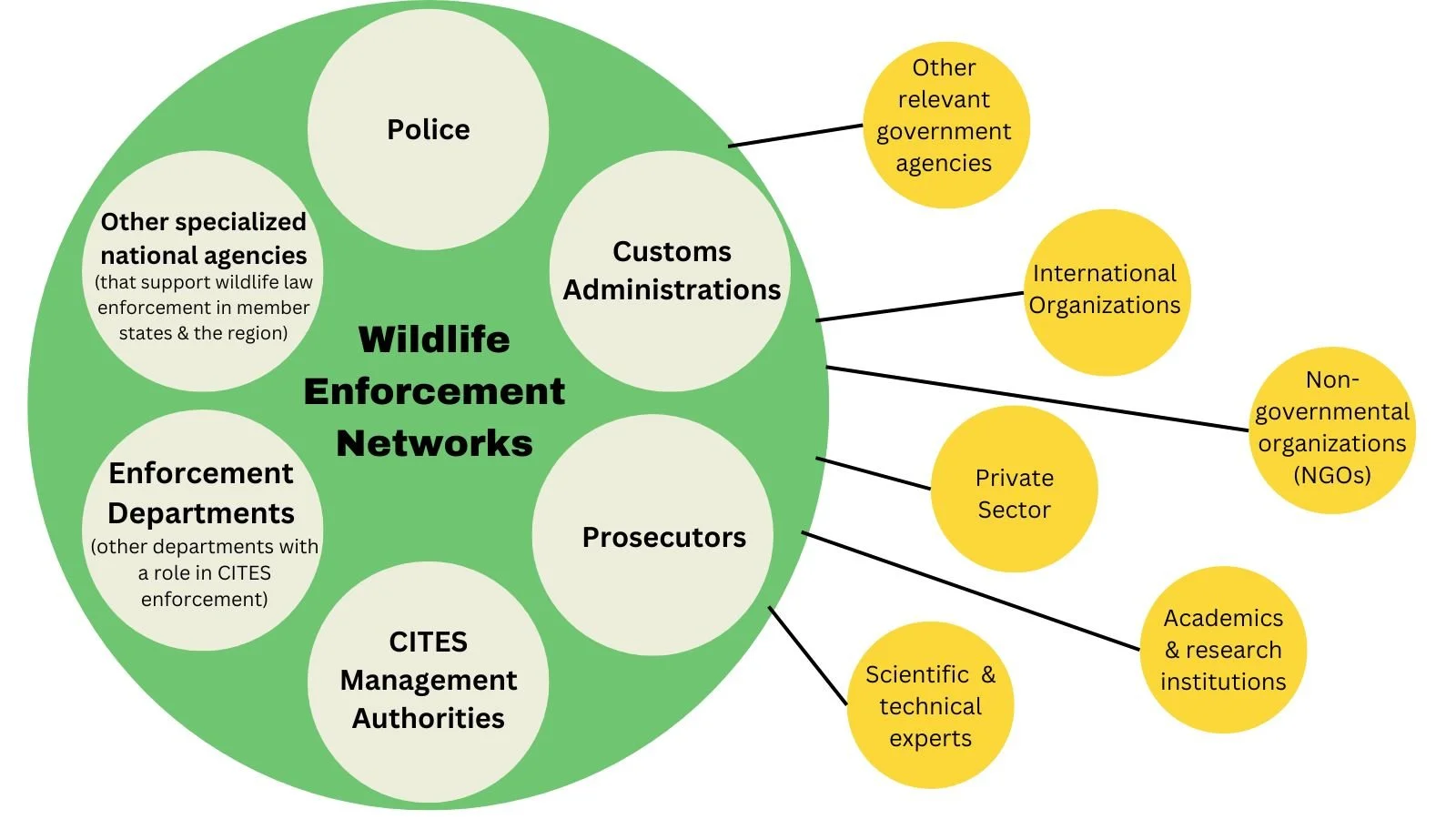
The WEN Concept Credit: ICCWC
How the WEN Model Emerged
The WEN model emerged because wildlife crime increasingly demanded standing cross-border co-ordination rather than isolated national responses. Trafficking routes often move through multiple jurisdictions. Wildlife products may be sourced in one place, transported through another, and sold elsewhere. A network model offered a way to make co-operation more regular, better organised, and better matched to the transboundary nature of the problem.
One early and influential example was the ASEAN-WEN, launched in 2005. It is especially instructive because it was embedded in a wider regional multilateral setting rather than existing only as a detached network. CITES described it at launch as an integrated network expected to deliver an effective coordination and information-sharing mechanism among agencies at both national and regional levels. That showed that wildlife-enforcement networking could be built into a broader regional architecture while still focusing on practical enforcement co-operation.
The model also proved useful because it could operate at multiple scales simultaneously. Regional co-operation mattered, but so did national inter-agency arrangements that connected domestic institutions to the wider network. Over time, that multilevel logic spread. ICCWC’s later guidance for new and existing WENs, together with the global meetings it has convened for WEN practitioners, shows that the “WEN” is now a recognised field of institutional form rather than a handful of disparate initiatives.
How the Model Can Vary
One of the most important things to understand about WENs is that the model is flexible. Networks can differ in institutional setting, governance structure, degree of formality, and practical emphasis. The ASEAN-WEN illustrates a model tied closely to a wider regional multilateral framework. The Lusaka Agreement Task Force (LATF), by contrast, sits on a treaty basis and serves as both the Secretariat and operational arm of the Lusaka Agreement. The SAWEN describes itself as a regional intergovernmental body for wildlife law enforcement support, operating from a Secretariat in Kathmandu. The ROAVIS functions as a formal regional network, established through an MOU signed by the Attorneys General and Solicitors General of its member countries. These examples are all recognisably within the WEN tradition, but they are not institutionally identical.
WENs can also vary in degree of formality. Some are more tightly structured and institutionalised, while others are lighter coordination mechanisms that still play an important role. That flexibility is part of the model’s strength. It means a region does not need to replicate a single institutional form to benefit from enforcement networking. Instead, it can build a network that aligns with its own political, legal, and administrative realities while still performing recognisable WEN functions. In this sense, a WEN can grow into being. Through the CAR-WEN Working Group, we are already developing a range of activities associated with WENs, by design, while working toward fuller formalisation through our operational framework, planning documents, pilot projects, and stakeholder engagement.
The model can also vary in who leads or drives it. Most classic WENs are governmental or intergovernmental at their core, but wildlife-enforcement networking can also take more civilian forms. The EAGLE Network is a useful example, as it grew out of a model of NGO-government collaboration focused on the prosecution of major traffickers and confronting corruption, and was later replicated across multiple African countries. That does not make EAGLE identical to a classic inter-governmental WEN, but it does show that wildlife-enforcement networking can also take a more civil-society-led form while still pursuing many of the same ends.
Variation is not only about institutional structure. It is also about emphasis and function. Some WENs lean more towards operations, investigations, and intelligence. Others lean more towards policy harmonisation, institutional support, capacity-building, legal development, communication, or information systems. The SAWEN emphasises policy harmonisation, institutional capacity strengthening, and knowledge and intelligence sharing. The LATF highlights co-operative law-enforcement activities, investigations, information exchange, databases, and capacity-building. The ROAVIS highlights communication between governments, information exchange, multinational operations, and training for judges, prosecutors, police, customs, and other authorities. The lesson is not that one model is necessarily better than another, but that the WEN model is highly adaptable.
What the WEN Model Can Do for the Wider Caribbean
At the most basic level, WENs can improve communication, intelligence sharing, coordination, and joint action against wildlife crime. Those are among the most traditional and widely recognised functions of the model. The ASEAN-WEN was launched with a strong emphasis on coordination and information-sharing. The LATF describes itself as facilitating co-operative enforcement operations, investigations, dissemination and exchange of information, and capacity-building. The ROAVIS highlights communication between governments, information exchange, and national, binational, and trinational operations. These are all practical examples of what enforcement networking can make possible when agencies have a structured platform for working together.
But the model can do much more than just support direct operations. WENs can also strengthen training and capacity-building, support legal and policy harmonisation, encourage national inter-agency task forces, improve information management, and deepen institutional relationships between agencies that otherwise work in isolation. The SAWEN’s official materials explicitly emphasise policy harmonisation and institutional capacity strengthening. ICCWC’s guidance similarly makes clear that support arrangements, network deliverables, self-assessment, and organisational development are part of the model’s logic, not peripheral extras. In other words, a WEN can help regions build the conditions for better enforcement, rather than responding only after a crime has already occurred.
The model also leaves room for regions to develop broader functions where needed. WENs can support strategy, partnership-building, data systems, fundraising, public awareness, technical learning, and monitoring. Some existing networks already show parts of that wider potential. The LATF highlights databases and awareness alongside operations and investigations. The ROAVIS combines operations with training and institutional strengthening. The SAWEN includes collaboration with regional and international partners as part of its role. That range suggests that the WEN model is open rather than closed. Regions can decide what kinds of assistance, coordination, and institutional support they most need, and shape their WEN accordingly.
That matters for the Wider Caribbean because the region faces the same broad coordination challenge that led other regions to build WENs in the first place. Wildlife crime and enforcement problems cross borders, institutions, and sectors. They involve marine and terrestrial species, legal and illegal trade chains, multiple enforcement authorities, and a mix of national and regional governance challenges. The Caribbean, therefore, does not need to invent an entirely new category of institution from scratch. It can build within an already established organisational tradition while adapting the model to Caribbean realities.
That is one reason the CAR-WEN Working Group is best understood within this wider WEN tradition. The Working Group is laying a foundation for a formalised regional enforcement network using the WEN organisational model and commonly employed core documents, while our activities, including network formalisation, planning and fundraising, and pilot projects, are deliberately building functions associated with WENs.
Building Toward Regional Action
The WEN model matters because it shows that regional wildlife-enforcement co-operation can be organised, strengthened, and sustained through institutions designed for that purpose. It also shows that there is no single path to doing so. Regions can build networks that fit their own geography, institutions, and strategic needs, while still working within a recognisable model of organised co-operation against wildlife crime.
For the Wider Caribbean, that is an important insight. It means the CAR-WEN’s work should be understood not as an isolated experiment, but as part of an established pattern of enforcement networking, adapted to the region's needs and possibilities. Once that model is understood, it becomes much easier to understand the CAR-WEN’s own institution-building choices and why the Working Group is investing so much effort in formalisation, planning, collaboration, and long-term network design. In later posts, we will look more closely at some of those choices, including governance, strategy, and the practical tools now being developed to support the network’s operations.
To learn more about how CAR-WEN is applying this model in the Wider Caribbean, visit our Operational Framework and Activities pages.
Further Reading
CAR-WEN Working Group. Strategic Plan for the Caribbean Wildlife Enforcement Network. Version 2.1. [PDF].
EAGLE Network. Our Members. [WEB]
International Consortium on Combating Wildlife Crime. (2020). ICCWC Guidelines for Wildlife Enforcement Networks (WENs). [PDF].
Lusaka Agreement Task Force. (2005). Strategic plan 2005-2015 [PDF].
South Asia Wildlife Enforcement Network. (2014). Statute of the South Asia Wildlife Enforcement Network (SAWEN) [PDF].
Red de Observancia y Aplicación de la Normativa de la Vida Silvestre de Centroamérica y República Dominicana. (2010). Memorándum de Entendimiento. [PDF].
Ministerio de Relaciones Exteriores del Perú. (2025). Términos de Referencias de SudWEN [PDF].
