The CAR-WEN Strategic Plan: An Adaptable Playbook for a Regional Network
As we work towards establishing the Caribbean Wildlife Enforcement Network (CAR-WEN), we are making decisions that will shape its future. What should we prioritise during establishment? What support should the network provide to participating agencies? And how could its work develop as participation, resources and experience grow? Our Strategic Plan brings our thinking on these questions together, giving governments and partners a starting point for shaping that development.
We see the plan as an adaptable playbook. It proposes strategies for establishing the network, developing foundational operations and expanding its capabilities, alongside ideas for external support. These proposals can evolve as participating governments and partners identify priorities, learn from experience and find opportunities to work together.
In this post, we explain how we developed the plan, why we propose these areas of work, and how they could support cooperation against wildlife crime in the Wider Caribbean.
Developing the Strategic Plan
Development of the Strategic Plan began in May 2023 through an initial assessment of wildlife crime in the Wider Caribbean and the potential role of a regional enforcement network. As participation in the Working Group expanded, government focal points, civil society representatives and technical contributors were invited to consider and refine the emerging strategies. Consultation proceeded through one-on-one conversations, small-group discussions and review of successive drafts, allowing the plan to develop alongside the community it was intended to serve.
To structure this work, we adopted the Open Standards for the Practice of Conservation, a framework for assessing problems, planning interventions and evaluating their results. The framework was useful because it required us to consider both the factors contributing to wildlife crime and how proposed strategies might address them. In this way, the planning process encouraged us to explain the reasoning connecting proposed activities with intended outcomes.
The application of the Open Standards also required adaptation to the Working Group’s broader concerns. Specifically, our scope includes animal welfare, biodiversity conservation, human well-being, public health and the rule of law. Our assessment therefore considered wildlife crime in relation to economic, governmental, environmental and societal factors, providing a basis for strategies that extend beyond conventional enforcement responses.
Alongside the Open Standards, we drew upon the International Consortium on Combating Wildlife Crime’s (ICCWC) Guidelines for Wildlife Enforcement Networks and USAID’s Measuring Efforts to Combat Wildlife Crime toolkit. Together, these resources helped inform the plan’s institutional and intervention strategies. The resulting theories of change describe how we expect those strategies to support the network’s development and reduce wildlife crime. These expectations remain assumptions to be examined through implementation, with further consultation and experience informing their revision.
In its current form, the Strategic Plan brings together an assessment of wildlife crime in the Wider Caribbean, our proposed approach to addressing it, and 24 supporting strategies across different stages of network development. Specifically, the plan organises network development into three core stages: Establishment, Foundational Operations and Expanded Operations. A fourth stage, External Support, identifies contributions that external actors could make alongside the network’s development and operation. In the following sections, we explore what we currently envisage for each stage and the reasoning behind its proposed strategies.
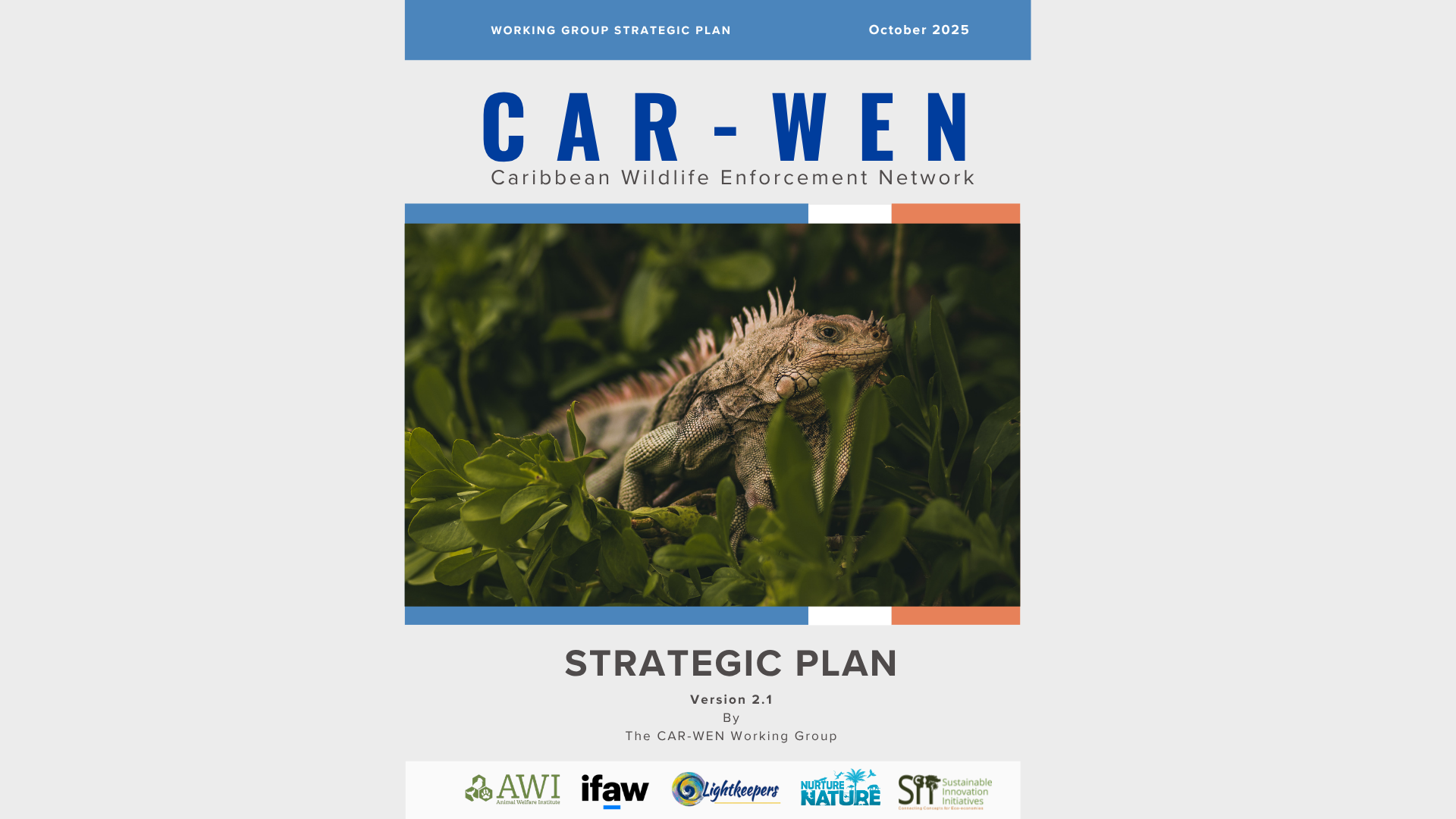
CAR-WEN Strategic Plan Credit: CAR-WEN Working Group
Establishing the CAR-WEN
Establishment is the stage we are currently working through as the CAR-WEN Working Group. Our immediate task is to develop the participation, institutional arrangements and resources needed for a functioning regional network, while undertaking practical work that can inform its development. Six strategies guide this process: Network Facilitation, Social Marketing, Formalising the CAR-WEN, Planning and Fundraising, Catalysing Pilot Projects, and External Stakeholder Engagement.
Our six establishment strategies are intended to work together to build participation, agree on institutional arrangements and mobilise support for practical cooperation. Network facilitation and formalisation address the related needs for sustained interaction among governments and agreement on how the network should operate. Through regular meetings and engagement with governmental focal points, we are identifying shared concerns, discussing priorities and developing opportunities for cooperation. These discussions also provide a basis for reviewing the proposed non-binding Memorandum of Understanding (MOU) and its accompanying Technical Note. Specifically, these documents allow governments to consider the network’s purpose, how decisions would be made and what participation would involve. In this way, the development of formal arrangements is informed by the institutions expected to use them.
The network’s establishment also requires understanding and support beyond its immediate governmental participants. Social marketing and external stakeholder engagement contribute in different ways: our website, presentations and explanatory materials communicate the initiative to interested audiences, while targeted discussions with donors, multilateral organisations and civil society partners explore particular opportunities for collaboration. Planning and fundraising help translate this interest into supported activities. We are developing projects and facilitating funding applications by NGOs and government agencies, including identifying suitable opportunities, bringing partners together and preparing proposals with defined activities, responsibilities and budgets. This work reflects our expectation that the CAR-WEN’s contribution will depend substantially on projects undertaken through participating institutions, alongside resources for the network’s own coordination.
Catalysing pilot projects allows us to develop useful forms of support while examining what their wider application would require. For instance, the Rapid Assessment Toolkit for Wildlife Crime and Enforcement responds to the need for practical guidance on selecting and conducting assessments suited to particular information needs. A working prototype has been produced, with collaborative refinement and planned pilot testing intended to assess its application. The Biodiversity Manager Platform addresses the related need to organise and use information, tools and working processes for wildlife enforcement and broader biodiversity governance. It remains in early development, with evaluation planned before broader access. Through these initiatives, we can examine the usefulness of proposed support, identify improvements and better understand the expertise and resources needed for its continued provision.
Together, these activities allow practical collaboration and institutional development to inform one another. Experience from projects can help clarify what participants need from the network, while agreed arrangements and sustained funding can support cooperation beyond individual projects. We therefore envisage establishment as a period in which the network’s proposed role is both negotiated and tested through initial work. Following signature of the MOU, the CAR-WEN would transition into full Foundational Operations, with member priorities and available funding guiding the scope and pace of implementation.
Developing Foundational Operations
The Foundational Operations stage would build upon the network’s formalisation through the non-binding MOU to provide continuing coordination and support to participating institutions. The scope and pace of this work would depend on member priorities and available funding. Six strategies guide our proposed approach: Network Establishment and Management; Enforcement Capacity Building; Behaviour Change Promotion; Knowledge Creation and Management; Legal, Regulatory, and Policy Reform; and Provision of Technical Tools and Services.
Our six foundational strategies connect the management of the network with practical support for preventing and responding to wildlife crime. Specifically, a dedicated Management Unit would help members agree on priorities, develop funded projects and coordinate their implementation. Core funding would sustain this continuing function, while additional funding would support projects undertaken with participating institutions and technical partners. Knowledge creation and management would improve the information available to guide this work through proposed regional databases, wildlife crime reports and research collaborations. More consistent recording and analysis of wildlife offences, for instance, could help members identify shared problems and determine where joint investment would be useful.
Enforcement capacity building and technical services would address limitations in the personnel, resources and expertise available to investigate wildlife offences. Improving evidence collection may require practical training alongside suitable equipment, handling procedures and access to specialist advice. The work of the African Wildlife Forensics Network illustrates how these needs can be addressed together. Its first-responder crime-scene guide, training materials and equipment recommendations make specialist knowledge available through resources that support its practical application. For the CAR-WEN, this provides a useful reference for developing assistance suited to practitioners’ working circumstances, with provision for continued advice and maintenance of the tools supplied.
The application of these capabilities also depends on the legal and institutional arrangements through which cases proceed. Our legal, regulatory, and policy reform strategy therefore envisages assistance with identifying weaknesses in legislation and procedures, developing appropriate reforms and supporting their implementation. Relevant experience can be found in Uganda, where the Uganda Conservation Foundation and its partners supported legal qualifications and helped facilitate a judicial workshop at which wildlife and forestry sentencing guidelines were approved for incorporation into national sentencing guidelines for non-capital offences. Here, professional development proceeded alongside nationally led improvements in judicial guidance. A similar contribution by the CAR-WEN would depend on the needs and decisions of participating authorities.
Alongside these enforcement-oriented activities, behaviour change promotion would address the motivations and circumstances associated with harmful practices. We envisage campaigns directed towards particular audiences, with research informing the choice of messages and delivery partners. For example, TRAFFIC’s Chi initiative in Viet Nam used research into rhino-horn consumption to develop messaging about success and social status, while business associations and other influential groups helped reach the intended consumers. This approach could inform the development of campaigns addressing illegal wildlife purchases in the Caribbean. However, the audiences, motivations and suitable interventions would need to be established locally, with evaluation examining whether the campaigns influence the targeted practices.
Taken together, these strategies would establish a continuing capacity to identify priorities, organise assistance and assess its contribution. Experience elsewhere offers resources and approaches to examine, while members would determine what is appropriate for their circumstances. We regard this work as foundational because its organisational, informational and technical capabilities would also support the more specialised forms of cooperation considered under Expanded Operations.
Expanding the Network’s Operations
The Expanded Operations stage considers how the CAR-WEN could broaden its contribution as members develop experience, identify further priorities and secure additional support. Six strategies guide this proposed development: Alternative Livelihoods Development; Wildlife Rehabilitation, Sanctuary, and Release; Intelligence Gathering, Sharing and Analysis; Joint Operations; National Wildlife Enforcement Networking; and Biosecurity Surveillance and Control.
We consider these strategies expansionary because their implementation may require specialised capacities, operational authority and sustained resources that the network cannot assume it will possess. Facilitating a joint enforcement operation, for instance, is different from having the personnel, equipment and authority to conduct it. Similarly, developing a viable livelihood programme requires expertise and continuing support beyond identifying an alternative source of income. Our role would therefore depend on member priorities, capacities already available within participating institutions and opportunities to work with suitable partners. Where these conditions exist, the network could facilitate particular activities earlier, without first developing every capability itself.
Intelligence sharing, joint operations and national wildlife enforcement networking illustrate these considerations. Cooperation across borders depends partly on agencies being able to organise and exchange information within their own jurisdictions. For example, Operation Thunder 2025, coordinated by INTERPOL and the World Customs Organization, brought together police, customs and wildlife authorities following months of information exchange and preparation for cross-border investigations. The CAR-WEN could support comparable cooperation by helping members identify shared priorities, strengthen national coordination and develop arrangements for secure information exchange directly between the responsible government authorities. Consistent with the proposed MOU, the network’s role would be to facilitate this cooperation without itself receiving, holding, processing or transmitting operational information or intelligence.
Wildlife rehabilitation, sanctuary and release similarly require facilities and continuing care that a coordination network would not necessarily provide directly. Relevant experience exists within the Wider Caribbean: ARCAS’s rescue centre in Petén, Guatemala receives confiscated wildlife under an agreement with the government and provides quarantine, veterinary care and rehabilitation, with release coordinated with national authorities where appropriate. This illustrates how enforcement agencies can work with specialist organisations to address wildlife care needs. The CAR-WEN could help assess existing capacity, connect agencies with care providers and develop funding proposals for identified gaps. Biosecurity surveillance and control would require related cooperation with veterinary, customs and public health authorities, drawing upon their existing systems while identifying needs for additional surveillance, testing or quarantine capacity.
Alternative livelihoods development presents a different but equally substantial implementation challenge. Training people in a new activity does not establish whether it can provide a viable income or reduce participation in wildlife crime. The experience of Community Markets for Conservation (COMACO) in Zambia illustrates the broader support that may be required. Its approach combines livelihood skills and agricultural assistance with purchasing participants’ produce for processing and sale, linking production to markets and conservation commitments. For the CAR-WEN, supporting such work would require partners with community-development and enterprise expertise, alongside an assessment of local opportunities and economic feasibility. The network could help convene these partners and develop projects, while implementation would depend on organisations equipped to sustain the work and evaluate its economic and conservation outcomes.
Expanded Operations therefore represents a set of possibilities to develop selectively, according to what members need and what the network and its partners can realistically support. The distinction concerns the requirements for implementation, rather than the relative importance of the strategies. It also highlights the potential contribution of organisations beyond the network. The plan’s fourth stage, External Support, considers contributions that could assist the CAR-WEN throughout its establishment and operation.
External Support for Wildlife Enforcement Networks
The fourth stage, External Support, considers contributions that universities, civil society organisations, donors and technical institutions could develop alongside the CAR-WEN’s three core stages: Establishment, Foundational Operations and Expanded Operations. These contributions could also benefit other wildlife enforcement networks (WENs). Six strategies identify possibilities: Evidence of Effective WEN Operations; Empower Wildlife Guardian Communities; Establish an Inter-American Wildlife College; Develop Wildlife Crime Data Collection and Analysis Tools; Adapt the Open Standards to Support WEN Operations; and Enhance Funding and Technical Assistance for WENs.
Our six external support strategies address needs that extend beyond the immediate responsibilities and resources of an individual network. For instance, comparative research could examine how different WENs are governed, funded and operated, and what evidence exists of their effectiveness. Such work could help distinguish arrangements that are useful across contexts from those dependent on particular institutional circumstances. The findings could also inform donors’ decisions about funding and technical assistance. The plan therefore proposes both a stronger evidence base and consideration of shared support mechanisms, including the possibility of an international fund for WENs. These are opportunities for external leadership and collaboration, rather than commitments the CAR-WEN could fulfil independently.
Professional education provides a further area in which a shared initiative could support many institutions. The proposed Inter-American Wildlife College would bring together curricula, trainers, fellowship opportunities and practical training sites across the Americas. The Southern African Wildlife College offers relevant experience in developing a regional institution for conservation education and professional training. For the Americas, we envisage exploring how existing educational institutions, enforcement agencies and conservation organisations could contribute to a collaborative model, with its form determined through assessment and consultation. Related support for wildlife guardian communities would focus on locally led participation, including education, citizen science and participatory action research through which communities could investigate problems and develop their own responses.
Shared tools and methods could similarly reduce the burden on individual networks to develop resources independently. For example, the SMART Partnership provides tools for collecting, analysing and reporting conservation data, supported by training and assistance for practitioners. This illustrates how a technical partnership can maintain resources used by multiple institutions. Our proposal for wildlife crime data collection and analysis tools concerns comparable support for consistent, adaptable methods, with opportunities to build upon existing resources. Adapting the Open Standards would address a related methodological need: developing guidance that better reflects wildlife enforcement work and its concerns with animal welfare, biodiversity, human well-being, public health and the rule of law.
The distinction between these proposals and our own stakeholder engagement is important. Stakeholder engagement seeks relationships and assistance for the network’s work; External Support also identifies initiatives that other actors could lead, maintain and make available more widely. The CAR-WEN could contribute by articulating needs, participating in research and testing, and sharing experience. Whether particular proposals advance would depend on the interest, capabilities and priorities of potential collaborators. In this way, the plan provides both a basis for developing the network and an invitation to consider the wider support that could help it function.
A Living Playbook
Taken together, the CAR-WEN Strategic Plan’s four stages describe how we envisage establishing the network, developing its operations and encouraging contributions from external partners. They connect the institutional work already underway with proposals for practical cooperation against wildlife crime in the Wider Caribbean. This is our current assessment of what the network could contribute and how that contribution might develop.
Nevertheless, we regard the plan as a living playbook. Its priorities and strategies should be revisited as participating governments and partners identify needs, gain experience and encounter new opportunities. Some activities may become feasible earlier than anticipated, while others may require substantial revision or prove unsuitable. The plan provides a basis for making these decisions together, with implementation informing its continued development.
We invite participating governments, practitioners, researchers and potential partners to read the Strategic Plan and help shape its further development. By sharing suggestions, relevant experience or proposals for collaboration, readers can help us refine the proposed strategies and identify opportunities for practical cooperation. These contributions would help ensure that the network’s development reflects the needs of the institutions and communities it is intended to serve.
Sources and Further Reading
A Strategic Plan for the Caribbean Wildlife Enforcement Network, Version 2.1. The full plan, including its assessment of wildlife crime, proposed approach and 24 supporting strategies. Available in English.
Open Standards for the Practice of Conservation, Version 4.0. The framework that informed our approach to assessing problems, developing strategies and evaluating results. Available in English, Spanish and French.
ICCWC Guidelines for Wildlife Enforcement Networks. Guidance on establishing and strengthening wildlife enforcement networks, which informed the plan’s proposed stages and strategies. Available in English, Spanish and French.
Measuring Efforts to Combat Wildlife Crime: A Toolkit for Improving Action and Accountability. A USAID-supported resource for planning wildlife crime interventions and assessing their results, which helped inform our selection of strategies. Available in English.
